You’ve tried one before. Thick, weirdly sweet, and somehow both chalky and watery at the same time. You chugged it anyway because, hey, gains.
But what if a protein smoothie could actually taste good? Like, look-forward-to-waking-up-for-it good?
That’s exactly what this post is about. Three protein smoothie recipes that are creamy, filling, and genuinely delicious, plus every tip, trick, and shortcut you need to make them part of your actual routine.
Recipe at a Glance
| Detail | Green Power Smoothie | Chocolate Peanut Butter | Berry Vanilla Blast |
|---|---|---|---|
| Prep Time | 5 mins | 5 mins | 5 mins |
| Calories | ~380 kcal | ~430 kcal | ~360 kcal |
| Protein | ~30g | ~35g | ~28g |
| Best For | Morning fuel | Post-workout | Light meal replacement |
| Difficulty | Easy | Easy | Easy |
Why Protein Smoothies Actually Work
Here’s the thing most people get wrong: they treat protein smoothies like a chore.
They throw in a scoop of powder, some milk, a banana, and call it done. Then they wonder why they’re hungry an hour later or why it tastes like flavored chalk.
A good protein smoothie needs three things:
- A quality protein source (not just powder)
- Healthy fats to slow digestion and keep you full
- Fiber from whole fruits or vegetables
Get those three right, and you’ve got a meal that fuels you for 3 to 4 hours straight.
Fun fact? Studies show that high-protein breakfasts reduce overall calorie intake throughout the day by curbing hunger hormones like ghrelin. Your smoothie is doing more than you think. 🙌
What You’ll Need
For the Green Power Smoothie
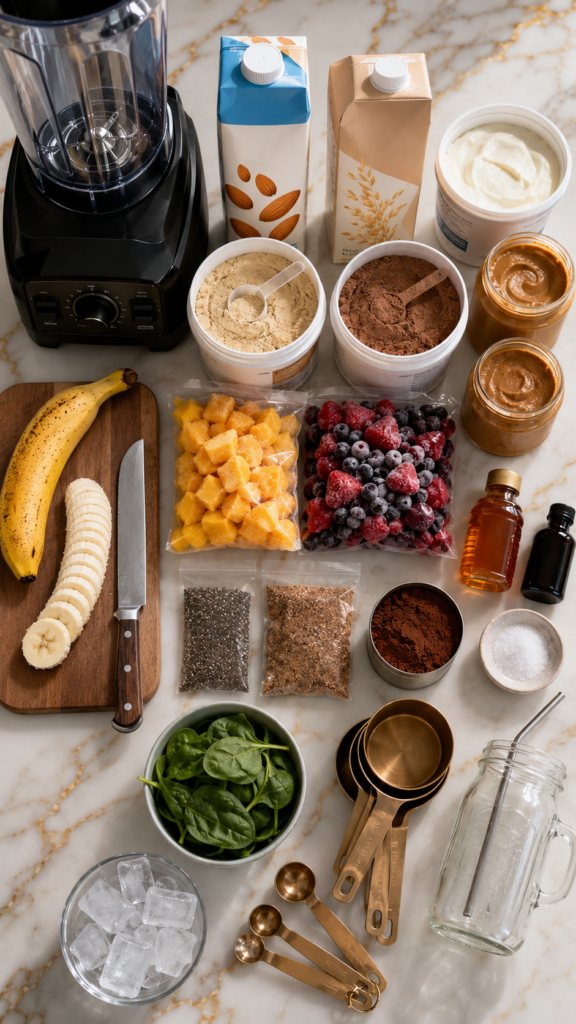
- 1 cup unsweetened almond milk (or milk of choice)
- 1 scoop vanilla protein powder (~25g protein)
- 1 cup fresh baby spinach
- 1 frozen banana (sliced before freezing)
- 1/2 cup frozen mango chunks
- 1 tablespoon chia seeds
- 1 teaspoon honey (optional)
- 3 to 4 ice cubes
For the Chocolate Peanut Butter Smoothie
- 1 cup unsweetened oat milk
- 1 scoop chocolate protein powder (~25g protein)
- 2 tablespoons natural peanut butter
- 1 frozen banana
- 1 tablespoon cocoa powder (unsweetened)
- 1 cup ice
- Pinch of sea salt
For the Berry Vanilla Blast
- 1 cup plain Greek yogurt (full-fat, 2% or whole)
- 1/2 cup unsweetened almond milk
- 1/2 scoop vanilla protein powder
- 1 cup mixed frozen berries (blueberries, raspberries, strawberries)
- 1 tablespoon almond butter
- 1 teaspoon vanilla extract
- 1 tablespoon ground flaxseed
Tools You’ll Need
- High-powered blender (a Vitamix or NutriBullet Pro works great; a basic blender will struggle with frozen bananas)
- Measuring cups and spoons
- Knife and cutting board
- Freezer-safe bags or containers (for prepping frozen bananas)
- Large glass or mason jar for serving
- Reusable straw (optional but makes it feel way more fun)
Pro Tips
1. Freeze your bananas before they overripen. Spotted bananas in your fruit bowl? Peel them, slice, freeze on a baking sheet for 1 hour, then transfer to a bag. They make smoothies thick and creamy without needing ice cream. Future you will be thrilled.
2. Add liquid first, then solids. Always pour your liquid into the blender before the frozen ingredients. This protects the blender motor and gets a smoother blend without air pockets.
3. Blend in stages for a creamy texture. Start on low, increase to high, blend for at least 60 full seconds. Stopping too early leaves chunks you’ll feel at the bottom of your glass.
4. Taste before you pour. Protein powders vary wildly in sweetness. Taste your smoothie before adding sweetener. You might not need it at all, especially with ripe frozen banana.
5. Go frozen over fresh for fruit. Frozen fruit is picked and frozen at peak ripeness, which means it’s often more nutritious than fresh fruit sitting in your fridge for a week. Plus, it makes your smoothie thicker without diluting it with ice.
How to Make Each Smoothie
Green Power Smoothie
- Add almond milk to the blender first.
- Add spinach and blend on medium for 20 seconds until smooth with no leaf chunks.
- Add frozen banana, mango, chia seeds, and ice.
- Blend on high for 60 seconds.
- Taste. Add honey if needed.
- Pour and drink immediately, or store (more on that below).
Chocolate Peanut Butter Smoothie
- Pour oat milk into the blender.
- Add peanut butter and cocoa powder.
- Blend for 15 seconds to mix the peanut butter in first (this prevents it from sticking to the blades).
- Add protein powder, frozen banana, and ice.
- Blend on high for 60 to 90 seconds.
- Add pinch of sea salt, blend 5 more seconds.
- Pour into a glass. It should be thick enough to eat with a spoon if you want it that way.
Berry Vanilla Blast
- Add almond milk and Greek yogurt to the blender.
- Add vanilla extract, protein powder, and flaxseed.
- Blend on low for 15 seconds.
- Add frozen berries and almond butter.
- Blend on high for 60 seconds until totally smooth.
- Taste and adjust vanilla or sweetness as needed.
Substitutions and Variations
| Ingredient | Swap | Why It Works |
|---|---|---|
| Almond milk | Coconut milk, oat milk, regular milk | Different fat and sugar profiles; all blend well |
| Protein powder | Collagen peptides, hemp protein, cottage cheese | Natural whole-food protein options |
| Peanut butter | Almond butter, sunflower seed butter (nut-free) | Same fat content, slightly different flavor |
| Frozen banana | Frozen cauliflower florets + dates | Lower sugar, still creamy |
| Greek yogurt | Silken tofu, coconut yogurt | Vegan-friendly swap |
| Oat milk | Any plant milk or dairy | Oat milk adds slight sweetness naturally |
Want more protein? Add a tablespoon of hemp seeds (10g extra protein) or a quarter cup of cottage cheese to any of these. It blends seamlessly and you won’t taste it.
Want it lower in sugar? Skip the banana and use half an avocado instead. Same creamy texture, way less sugar, and you add healthy fats on top.
Make-Ahead Tips
These are best fresh, but you can absolutely prep ahead.
Option 1: Freezer smoothie packs. Portion out all your dry and frozen ingredients into zip-lock bags. Label them. When you’re ready, dump the bag into the blender, add liquid, blend. Morning done.
Option 2: Blend and refrigerate. Smoothies keep well in the fridge for up to 24 hours in an airtight jar. Give it a shake before drinking as separation is totally normal.
Option 3: Freeze as smoothie cubes. Pour blended smoothie into an ice cube tray. Freeze. When you want one, blend the cubes with a splash of milk. Takes 2 minutes.
Nutritional Breakdown
Green Power Smoothie (per serving)
| Nutrient | Amount |
|---|---|
| Calories | ~380 kcal |
| Protein | ~30g |
| Carbohydrates | ~42g |
| Fat | ~9g |
| Fiber | ~7g |
| Sugar | ~20g (natural) |
Chocolate Peanut Butter Smoothie (per serving)
| Nutrient | Amount |
|---|---|
| Calories | ~430 kcal |
| Protein | ~35g |
| Carbohydrates | ~38g |
| Fat | ~16g |
| Fiber | ~6g |
| Sugar | ~18g (natural) |
Berry Vanilla Blast (per serving)
| Nutrient | Amount |
|---|---|
| Calories | ~360 kcal |
| Protein | ~28g |
| Carbohydrates | ~36g |
| Fat | ~11g |
| Fiber | ~6g |
| Sugar | ~22g (natural) |
Note: Nutritional values vary based on specific brands and portion sizes used.
Meal Pairing Suggestions
These smoothies are filling on their own, but if you want a full meal spread:
- Green Power pairs well with a slice of whole grain toast and two boiled eggs
- Chocolate Peanut Butter is great post-workout alongside a banana or a handful of oats
- Berry Vanilla Blast works as a midday snack with a few rice cakes
Leftovers and Storage
In the fridge: Store in a sealed mason jar for up to 24 hours. Expect some separation; that’s just physics, not spoilage. Shake it up and drink.
In the freezer: Pour into a freezer-safe container and freeze for up to 3 months. Thaw overnight in the fridge or re-blend straight from frozen with a splash of milk.
What NOT to do: Don’t leave a protein smoothie out at room temperature for more than 2 hours. Greek yogurt and protein powder are perishable once blended.
FAQ
Can I use water instead of milk?
You can, but the texture will be thinner and less creamy. If calories are a concern, try diluted coconut water instead; it adds natural electrolytes and a subtle sweetness.
Which protein powder is best for smoothies?
Whey protein blends the smoothest. For plant-based options, pea protein is the closest in texture. Avoid rice protein in smoothies as it tends to be gritty.
Can I make these without protein powder?
Absolutely. Swap the powder for an extra scoop of Greek yogurt, a quarter cup of cottage cheese, or two tablespoons of hemp seeds. You’ll hit a similar protein range naturally.
Why is my smoothie not filling me up?
You’re probably missing fat or fiber. Make sure your smoothie includes at least one fat source (nut butter, avocado, chia seeds, flaxseed) and fiber from whole fruit. Fat and fiber are what tell your brain you’re full.
Is it okay to have a protein smoothie every day?
Yes, as long as you’re using quality ingredients and not relying solely on processed protein powder. Whole food protein sources and rotating your fruits and vegetables keeps things nutritionally balanced.
Can kids have these?
The versions without added protein powder are great for kids. Stick to the fruit, yogurt, and nut butter versions and reduce sweetener.
My blender leaves chunks. What do I do?
Blend your leafy greens with liquid first before adding frozen ingredients. This extra step takes 20 seconds and makes a massive difference in texture.
Wrapping Up
Here’s the truth: protein smoothies have a bad reputation because most people make them badly.
Bad powder. Weak blender. No fat. No fiber. Then they wonder why it tastes like gym floor and leaves them hungry by 10am.
These three recipes fix all of that.
Pick one, make it tomorrow morning, and pay attention to how you feel three hours later. Full? Energized? Not thinking about snacks? That’s what a properly made protein smoothie feels like.
Come back and drop a comment below. Which one did you try? Did you swap anything out? Did the chocolate peanut butter one ruin all other breakfasts for you?
Ask away. I read every comment. 👇