
You’ve probably stared at a tray of perfect macarons in a bakery window and thought, there’s no way I’m making those at home.
I get it. They have a reputation.
But here’s the thing: macarons aren’t hard. They’re just precise. And once you understand why each step matters, the whole process clicks.
These little almond sandwich cookies come out with smooth, shiny tops, perfect little ruffled “feet,” and a filling that makes you close your eyes for a second. Make them once and you’ll want to make them every weekend.
Recipe At a Glance 📋
| Detail | Info |
|---|---|
| Prep Time | 45 minutes |
| Rest Time | 30-60 minutes |
| Bake Time | 12-14 minutes |
| Total Time | ~2 hours |
| Yield | 20-24 sandwich cookies |
| Difficulty | Intermediate |
| Best For | Gifting, parties, afternoon tea, impressing literally anyone |
What You’ll Need
For the Macaron Shells
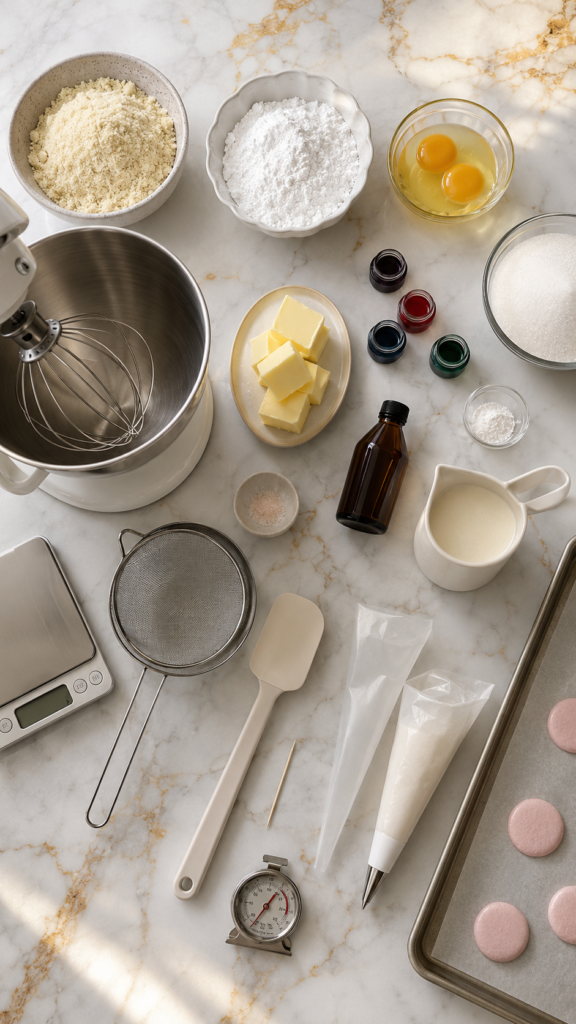
- 100g (1 cup) almond flour, finely ground
- 100g (¾ cup + 2 tbsp) powdered sugar
- 75g egg whites (from about 2 large eggs), aged if possible
- 75g (⅓ cup) granulated sugar
- ¼ tsp cream of tartar
- Gel food coloring (optional)
- 1 tsp pure vanilla extract
For the Vanilla Buttercream Filling
- 115g (½ cup / 1 stick) unsalted butter, softened
- 200g (1¾ cups) powdered sugar, sifted
- 2-3 tbsp heavy cream
- 1 tsp pure vanilla extract
- Pinch of salt
Tools You’ll Need
- Kitchen scale (non-negotiable — cups alone won’t cut it here)
- Stand mixer or hand mixer with whisk attachment
- Fine mesh sieve or sifter
- Large mixing bowls
- Silicone spatula
- Piping bags (at least 2)
- Round piping tip (Wilton #12 or similar)
- Baking sheets (2-3)
- Parchment paper or silicone macaron mats
- Toothpick
- Oven thermometer (your oven is probably lying to you about its temperature)
Pro Tips
These are the things I wish someone had told me before my first batch came out looking like sad little pancakes.
- Age your egg whites. Separate your eggs 24-48 hours ahead and leave the whites uncovered in the fridge. This dries them out slightly and makes for a more stable meringue. Is it mandatory? No. Does it make a difference? 100% yes.
- Sift your almond flour twice. Any lumps left in the almond flour show up on the surface of your shells and you’ll never stop noticing them. Sift it, weigh it again after sifting (you’ll lose some), and sift once more.
- Macaronage is everything. This is the folding step where you deflate the batter to the right consistency. Fold until the batter flows like slowly moving lava and a ribbon dropped from the spatula disappears back into the batter within 10 seconds. Too stiff = no feet. Too loose = flat, spreading pancakes.
- Let them rest before baking. After piping, leave the trays out for at least 30 minutes (up to an hour in humid weather). They should form a dry skin on top that doesn’t stick when you lightly touch them. Skip this and the tops crack in the oven.
- Bake one tray at a time. Even airflow matters enormously. Bake on the middle rack, one sheet at a time. Your results will be way more consistent.
Substitutions and Variations
Fillings:
- Swap vanilla buttercream for chocolate ganache, lemon curd, raspberry jam + buttercream, or salted caramel
- Nutella works if you want something ridiculously easy and crowd-pleasing
Flavors:
- Add 1 tsp cocoa powder to the shells (replace equal weight of almond flour) for chocolate shells
- Add freeze-dried raspberry powder for a natural pink color and fruity flavor
- Matcha powder gives a gorgeous green and earthy flavor
- Espresso powder for a coffee version
Almond-free option:
- Sunflower seed flour is the closest sub, though it produces a slightly greenish color and nuttier flavor
Make-Ahead Tips
Macarons are actually better after they’ve had time to rest. This is called the “maturing” process.
- Assembled macarons taste best after sitting in the fridge for 24 hours — the filling softens the shells from the inside and the whole thing becomes this perfect, chewy, melty bite
- Unfilled shells can be stored in an airtight container at room temperature for 2 days or frozen for up to 3 months
- Buttercream can be made up to a week ahead and kept refrigerated; re-whip before using
Make the shells on Saturday, fill them Saturday night, and by Sunday brunch? Perfection.
Full Instructions
Step 1: Prep Your Workspace
Bring egg whites to room temperature (cold whites don’t whip as well).
Line your baking sheets with parchment paper. If you have a macaron mat template, slide it under the parchment.
Preheat oven to 300°F (150°C) — and use that oven thermometer to confirm it.
Step 2: Make the Almond Flour Mixture (Tant Pour Tant)
Sift almond flour and powdered sugar together into a large bowl.
Sift it again. Yes, twice.
Discard any large pieces that won’t pass through. Set aside.
Step 3: Make the Meringue
In a completely clean, grease-free bowl, beat egg whites on medium speed until foamy.
Add cream of tartar, then slowly pour in the granulated sugar while beating.
Increase speed to high and beat until you reach stiff, glossy peaks — the meringue should hold its shape and look like shaving cream. Add vanilla and food coloring here if using.
This takes about 5-7 minutes total.
Step 4: Macaronage (The Folding Step)
Add the almond flour mixture to the meringue all at once.
Using a silicone spatula, fold and press the batter against the sides of the bowl. You’re intentionally deflating the meringue a bit.
Test it every few folds: lift your spatula and let batter fall — it should flow in a thick, continuous ribbon. When you draw a figure-8 without the ribbon breaking, you’re done.
This usually takes 40-55 folds. Count them.
Step 5: Pipe the Shells
Transfer batter to a piping bag fitted with a round tip.
Hold the bag straight up, perpendicular to the pan. Pipe 1.5-inch circles, about 1 inch apart.
Tap the pan firmly on the counter 5-6 times to pop air bubbles. Use a toothpick to pop any remaining ones.
Step 6: Rest the Shells
Leave trays at room temperature for 30-60 minutes, until shells are no longer tacky and have formed a dry skin on top.
Don’t rush this. If your kitchen is humid, give them the full hour.
Step 7: Bake
Bake one tray at a time on the middle rack for 12-14 minutes.
The shells should develop their signature “feet” (those ruffled edges) within the first 5 minutes. That’s your sign things are working.
Let cool completely on the pan before removing. They’ll stick if you rush this.
Step 8: Make the Buttercream
Beat softened butter until light and fluffy, about 3-4 minutes.
Add sifted powdered sugar gradually, then vanilla, salt, and enough cream to reach a smooth, pipeable consistency.
Step 9: Fill and Assemble
Match shells in pairs of similar sizes.
Pipe a small amount of buttercream on the flat side of one shell. Press the matching shell on top gently.
Refrigerate assembled macarons in an airtight container for at least 1 hour, ideally overnight. This is what turns good macarons into great ones.
Nutritional Info (Per 1 Macaron Sandwich)
| Nutrient | Amount |
|---|---|
| Calories | ~110 |
| Carbohydrates | 14g |
| Protein | 2g |
| Fat | 6g |
| Sugar | 12g |
Naturally gluten-free.
Meal Pairing Suggestions
Macarons pair beautifully with:
- Earl Grey or chamomile tea for an afternoon situation
- Champagne or prosecco if you’re feeling fancy
- A cup of really good espresso — the bitterness cuts through the sweetness perfectly
- Fresh berries on the side for color and brightness at a party spread
Leftovers and Storage
| Method | Duration |
|---|---|
| Refrigerator (airtight container) | Up to 5 days |
| Freezer (assembled, airtight) | Up to 2 months |
| Room temp | 1-2 days max |
To freeze: place assembled macarons in a single layer, freeze until firm, then transfer to a freezer bag. Thaw in the fridge overnight. They come back to life beautifully.
FAQ
Why didn’t my macarons get feet? Usually one of three things: the batter was under-folded (too stiff), the shells weren’t rested long enough, or the oven temperature was off. Start with an oven thermometer — most home ovens run hot or cold.
My tops cracked. What went wrong? The shells needed more resting time before baking, or your oven is running too hot.
Can I make these without a scale? Technically, but macarons are a baking chemistry project. A few grams off can genuinely affect the result. A basic kitchen scale is like $10 and completely worth it.
Why do people age egg whites? Fresh egg whites have more moisture. Aging them (leaving uncovered in the fridge for 24-48 hours) reduces that moisture, which creates a more stable meringue and better structure in the shells.
My macarons are hollow inside. Help. Hollow shells usually mean the meringue was over-beaten or the baking temp was too high. Try lowering the temperature by 10°F and baking slightly longer.
Do I have to use gel food coloring? Liquid food coloring adds too much moisture and can mess with the meringue. Gel or powder coloring are the way to go.
Can I double the recipe? Yes, but it’s easier to do two separate batches rather than doubling, since the batter can deflate during a longer macaronage with a larger quantity.
Wrapping Up
Macarons have this unfair reputation as being impossible.
They’re not. They’re just a little bossy — they need you to follow the rules, use a scale, and not rush them. Do those things and they reward you with something that looks like it came out of a Parisian patisserie.
Make them for a birthday, a brunch, a holiday tray, or genuinely just a Tuesday when you want to feel fancy.
And when you do make them — drop a comment below. Tell me how they turned out, what filling you went with, and what questions you have. I read every single one.