
You’ve seen it on cooking shows. You’ve watched Gordon Ramsay make it look effortless. And now you’re wondering… can I actually pull this off at home?
Short answer: yes. And when you do, people will talk about it for years.
Beef Wellington is one of those dishes that sounds terrifyingly complicated but is actually more forgiving than you’d think. A tender beef tenderloin wrapped in a savory mushroom paste, then tucked inside flaky, golden puff pastry.
It’s the kind of meal that turns a Tuesday dinner into a full-on event.
Recipe at a Glance
| Detail | Info |
|---|---|
| Prep Time | 45 minutes |
| Chill Time | 30 minutes (minimum) |
| Cook Time | 25–30 minutes |
| Total Time | ~1 hour 45 minutes |
| Servings | 4–6 |
| Difficulty | Intermediate |
| Best For | Date nights, holidays, dinner parties |
What Exactly IS Beef Wellington?
Here’s the fun part. Beef Wellington isn’t actually British in origin — at least, food historians can’t fully agree on that.
Some say it was named after the Duke of Wellington after his victory at the Battle of Waterloo in 1815. Others say there’s no real connection at all and the dish was just given a patriotic name at some point.
Either way, you’re wrapping a beautiful piece of beef in pastry and calling it dinner. And honestly? No one’s complaining.
What You’ll Need
For the Beef
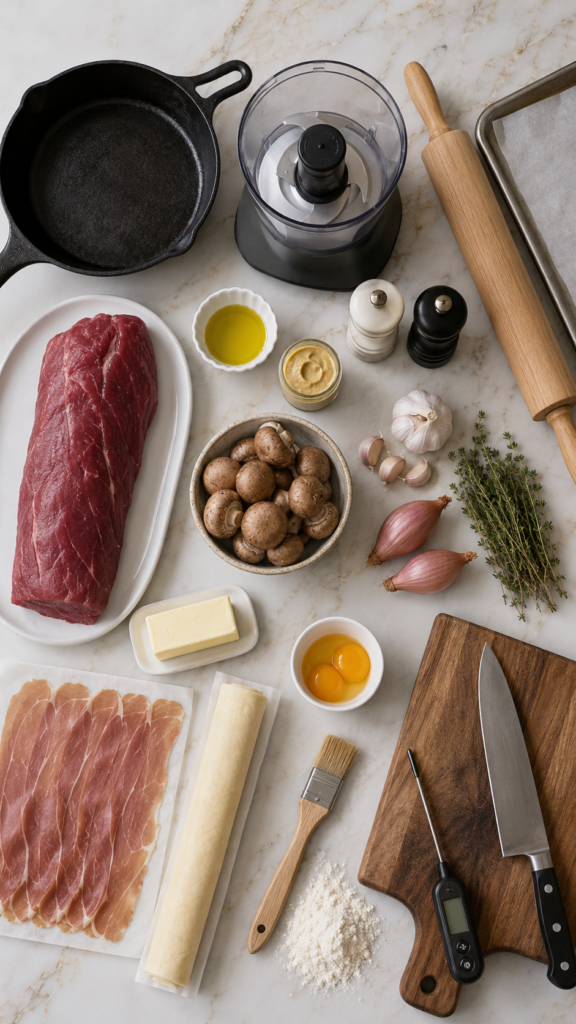
- 2 lbs (900g) beef tenderloin, center-cut, trimmed
- 1 tablespoon olive oil
- 2 teaspoons Dijon mustard
- Salt and black pepper to taste
For the Duxelles (Mushroom Paste)
- 1 lb (450g) cremini mushrooms, finely chopped
- 4 cloves garlic, minced
- 2 shallots, finely diced
- 2 tablespoons unsalted butter
- 1 tablespoon fresh thyme leaves
- Salt and black pepper to taste
For the Assembly
- 6–8 slices prosciutto or Parma ham
- 1 sheet (14 oz / 400g) puff pastry, thawed if frozen
- 2 egg yolks, beaten with 1 tablespoon water (egg wash)
- All-purpose flour, for dusting
Tools You’ll Need
- Cast iron skillet or heavy-bottomed pan — for searing the beef
- Food processor — for blitzing the mushrooms (or a sharp knife and patience)
- Plastic wrap / cling film — essential for shaping
- Rolling pin — for the pastry
- Baking sheet lined with parchment paper
- Meat thermometer — non-negotiable for getting the doneness right
- Sharp knife — for clean slices when serving
- Pastry brush — for the egg wash
Pro Tips
These are the things I wish someone had told me before the first time I made this.
- Dry out the duxelles completely. This is the single most important step. Wet mushrooms = soggy pastry = sad Wellington. Cook the mushrooms low and slow until every drop of moisture is gone. It takes longer than you think.
- Chill at every stage. After wrapping the beef in prosciutto, chill it. After wrapping in pastry, chill it again. Cold pastry goes into a hot oven and puffs up beautifully. Warm pastry slumps.
- Sear hard and fast. You want deep golden-brown color on all sides of the beef in just 1–2 minutes per side. You’re building flavor, not cooking it through. The oven does the rest.
- Use a meat thermometer. Guessing at doneness in a wrapped log of pastry is a bad idea. Pull it at 120–125°F for medium-rare, which is perfect for tenderloin.
- Rest before slicing. Give it a full 10 minutes after it comes out of the oven. Cutting into it early means all those beautiful juices end up on your cutting board instead of in your mouth. 😌
Make-Ahead Tips
This is actually one of the best things about Beef Wellington — you can prep almost everything the night before.
- Duxelles: Make it up to 2 days ahead and store in the fridge.
- Sear the beef: Do this the night before, brush with mustard, wrap in prosciutto, and refrigerate overnight.
- Fully assembled Wellington: Assemble (minus egg wash), wrap tightly in plastic wrap, and refrigerate for up to 24 hours. Pull it out 15 minutes before baking and add the egg wash right before it goes in.
This actually makes it easier to execute for a dinner party because there’s nothing chaotic happening in real time.
How to Make Beef Wellington
Step 1: Make the Duxelles
Add the mushrooms to a food processor and pulse until very finely chopped (you want a paste, not chunks).
Melt butter in a large skillet over medium heat. Add shallots and garlic, cook 2–3 minutes until soft.
Add the mushrooms and thyme. Season with salt and pepper.
Cook, stirring frequently, for 15–20 minutes until all moisture has evaporated and the mixture is dry and dark. This step is crucial. Set aside and let it cool completely.
Step 2: Sear the Beef
Pat the beef tenderloin very dry with paper towels. Season generously with salt and pepper on all sides.
Heat olive oil in a cast iron skillet over high heat until smoking.
Sear the beef 1–2 minutes per side, including the ends, until deep golden-brown all over.
Remove from the skillet and immediately brush all sides with Dijon mustard. Set on a wire rack and let cool completely. (20 minutes minimum — you don’t want warm beef melting your pastry later.)
Step 3: Wrap in Prosciutto
Lay a large sheet of plastic wrap on your work surface. Arrange the prosciutto slices in a thin, overlapping rectangle — big enough to fully wrap the beef.
Spread the duxelles in an even layer over the prosciutto.
Place the beef at the edge closest to you. Using the plastic wrap, roll the beef tightly into a log, twisting the ends to secure it.
Refrigerate for at least 30 minutes (or overnight).
Step 4: Wrap in Pastry
Preheat your oven to 425°F (220°C).
On a lightly floured surface, roll out the puff pastry to a rectangle large enough to wrap the beef log with a few inches of overlap.
Unwrap the beef from the plastic wrap and place at the edge of the pastry. Brush the pastry edges with egg wash.
Roll the beef up tightly in the pastry, pressing the seam to seal. Tuck the ends under and place seam-side down on a parchment-lined baking sheet.
Brush the entire outside with egg wash. If you want, score a light crosshatch or leaf pattern on top with a knife (purely for looks, but it’s a nice touch 🎨).
Refrigerate for 15–20 more minutes.
Step 5: Bake
Bake at 425°F for 25–30 minutes, until the pastry is deep golden brown and the internal temperature reads 120–125°F for medium-rare.
Remove from the oven and rest for 10 minutes before slicing.
Slice into thick rounds using a sharp knife and serve immediately.
Substitutions and Variations
Not everyone has access to the same ingredients, and that’s okay.
| Ingredient | Swap Options |
|---|---|
| Beef tenderloin | Pork tenderloin (cook to 145°F), or a venison loin |
| Prosciutto | Parma ham, thinly sliced Serrano ham |
| Cremini mushrooms | Any mix of mushrooms — shiitake, portobello, button |
| Puff pastry | Shortcrust pastry works but won’t be as dramatic |
| Dijon mustard | Whole grain mustard for a slightly different flavor |
Vegetarian version: Use a whole roasted portobello cap or a butternut squash core in place of the beef. Yes, it’s a thing and it’s actually really good.
Nutritional Breakdown (Per Serving, Based on 6 Servings)
| Nutrient | Amount |
|---|---|
| Calories | ~580 kcal |
| Protein | 38g |
| Fat | 34g |
| Carbohydrates | 28g |
| Fiber | 1g |
| Sodium | ~620mg |
Note: These are estimates and will vary based on the specific brands and exact quantities used.
What to Serve With Beef Wellington
This dish is rich, so you want sides that balance it rather than compete with it.
- Roasted asparagus or green beans — simple and bright
- Creamy mashed potatoes or dauphinoise potatoes — classic for a reason
- A simple red wine jus — made from the pan drippings and a splash of red wine, reduces down beautifully
- A crisp green salad with a light vinaigrette to cut through the richness
For wine, a full-bodied red works really well. Cabernet Sauvignon, Merlot, or a good Bordeaux are all solid choices.
Leftovers and Storage
Real talk: Beef Wellington is at its absolute peak the moment it comes out of the oven. The pastry is crispy, the beef is perfectly pink, and everything is at its best.
That said, leftovers are still good.
- Store: Wrap tightly in foil or an airtight container. Keep in the fridge up to 3 days.
- Reheat: Low and slow in a 300°F oven for 10–15 minutes. Avoid the microwave — it’ll make the pastry soggy and sad.
- Freezing: Not recommended once fully cooked. The pastry loses its texture. If you want to freeze, do it before baking at the fully assembled stage.
FAQ
Can I use a different cut of beef?
Technically yes, but tenderloin is the classic choice for a reason — it’s lean, tender, and cooks evenly. If you use a fattier cut like ribeye, you’ll have issues with rendering fat inside the pastry.
What if my pastry tears?
Patch it with a small piece of extra pastry and a dab of egg wash. Once it bakes, you honestly can’t tell.
How do I know when the duxelles is dry enough?
It should stick together in a paste when pressed and not leave any liquid behind on the pan. If it’s still glossy or wet-looking, keep cooking.
Can I make this for a crowd?
Yes! Make two smaller Wellingtons instead of one large one — they cook more evenly and are easier to slice and serve.
My pastry got soggy on the bottom. What happened?
Most likely the duxelles still had moisture in it, or the beef wasn’t fully cooled before wrapping. Both of these are easy to fix with the tips above.
Do I need prosciutto?
It plays two roles: adds flavor and creates a moisture barrier between the duxelles and the pastry. I wouldn’t skip it, but if you must, use a layer of thin-sliced ham or even a thin crêpe.
Wrapping Up
Here’s the thing about Beef Wellington. The first time you slice into it at the table and see those perfect layers — the pink beef, the dark mushroom paste, the golden pastry — you’re going to feel genuinely proud.
It’s the kind of dish that earns you a reputation. Your friends will ask you to make it again. Your family will request it for holidays. And you’ll have the satisfaction of knowing you made something that looks like it came from a restaurant kitchen.
Start with the make-ahead tips, take your time with the duxelles, and trust the thermometer. That’s really all it takes.
Give it a go and let me know how it turns out in the comments below! Did it come out perfectly golden? Did you try a variation? I’d love to hear about it — and if you ran into any snags, drop your questions and I’ll help you troubleshoot.