
You know that feeling when you walk into a house, and the smell alone stops you dead in your tracks?
That’s what this beef stew does.
It’s the kind of meal that makes people text you for the recipe before they’ve even finished their bowl. Thick, rich broth. Fork-tender beef. Vegetables that have been slow-cooked into something almost magical. And a depth of flavor that tastes like you’ve been cooking for hours — because you have been, but mostly hands-off.
If you’ve never made beef stew from scratch before, this is the one to start with. And if you have? This might just replace your old go-to.
Recipe at a Glance
| Detail | Info |
|---|---|
| Prep Time | 20 minutes |
| Cook Time | 2.5 to 3 hours |
| Total Time | ~3.5 hours |
| Servings | 6 |
| Difficulty | Easy |
| Method | Stovetop (Dutch oven) |
What You’ll Need
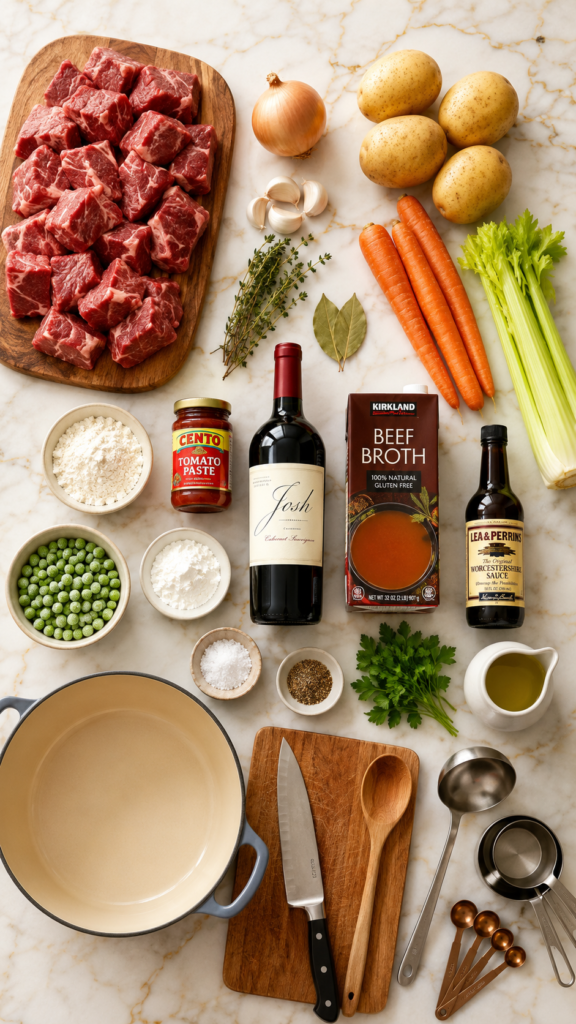
For the Stew
- 2.5 lbs (1.1 kg) beef chuck, cut into 1.5-inch cubes
- 3 tablespoons olive oil
- 1 teaspoon salt (plus more to taste)
- 1 teaspoon black pepper
- 3 tablespoons all-purpose flour
- 1 large yellow onion, diced
- 4 garlic cloves, minced
- 2 tablespoons tomato paste
- 1 cup dry red wine (Cabernet Sauvignon or Merlot work great)
- 3 cups beef broth (low sodium preferred)
- 1 cup water
- 2 teaspoons Worcestershire sauce
- 1 teaspoon fresh thyme (or 1/2 teaspoon dried)
- 2 bay leaves
- 4 medium Yukon Gold potatoes, cut into chunks
- 3 large carrots, sliced into thick rounds
- 2 celery stalks, sliced
- 1 cup frozen peas (added at the end)
- Fresh parsley for garnish
For the Slurry (Optional Thickener)
- 2 tablespoons cornstarch
- 2 tablespoons cold water
Tools You’ll Need
- Large Dutch oven (5-6 quart) or heavy-bottomed pot
- Sharp chef’s knife and cutting board
- Wooden spoon or silicone spatula
- Measuring cups and spoons
- Ladle for serving
Pro Tips
These are the things that make a good beef stew a great beef stew.
1. Dry your beef before searing. Pat those cubes completely dry with paper towels. Moisture is the enemy of a good sear — wet beef steams instead of browns, and you’ll miss out on all that deep, caramelized flavor.
2. Don’t rush the sear. Brown the beef in batches. Crowding the pan drops the temperature and you’ll end up steaming the meat again. Give each piece real contact with the hot surface and don’t move it for at least 2 minutes per side.
3. The fond is flavor gold. After searing, there will be brown bits stuck to the bottom of your Dutch oven. Don’t wash them — deglaze with the wine and scrape every single bit up. That’s pure concentrated flavor going straight into your stew.
4. Add potatoes and carrots later. If you add them too early, they’ll fall apart and turn mushy. Add them in the last 45-60 minutes of cooking for the perfect texture.
5. Taste and adjust at the end. Salt levels change as the stew reduces. Always taste and season right before serving — not just at the beginning.
Substitutions and Variations
Not everyone has the same pantry (or diet). Here’s how to make it work for you.
Beef chuck alternatives:
- Beef brisket — slightly leaner but still great for slow cooking
- Short ribs — richer flavor, incredible results
- Lamb shoulder — a totally different but delicious take
No red wine?
- Use extra beef broth with a splash of balsamic vinegar for depth
- Pomegranate juice works surprisingly well and adds a slight sweetness
Gluten-free?
- Skip the flour and just use the cornstarch slurry at the end to thicken
Low-carb version:
- Swap potatoes for turnips or cauliflower florets
Extra veggies you can throw in:
- Parsnips, mushrooms, green beans, or sweet potato all work here
Make-Ahead Tips
This stew is genuinely one of those dishes that tastes better the next day.
- Make it 1-2 days ahead and store covered in the fridge. The flavors meld and deepen overnight.
- Reheat on the stovetop over medium-low heat, adding a splash of broth if it’s thickened too much.
- Freeze it (without the potatoes — they don’t thaw well) for up to 3 months. Just add freshly cooked potatoes when you reheat.
The Full Instructions
Step 1: Prep the Beef
Pat beef cubes completely dry with paper towels.
Toss them with salt, pepper, and flour until evenly coated.
Step 2: Sear in Batches
Heat 1.5 tablespoons of olive oil in your Dutch oven over medium-high heat until it shimmers.
Add beef in a single layer — don’t crowd it. Sear for 2-3 minutes per side until deeply browned.
Remove to a plate and repeat with remaining beef. Set aside.
Step 3: Sauté the Aromatics
Lower the heat to medium. Add the remaining olive oil.
Sauté the onion for 4-5 minutes until soft and translucent.
Add garlic and tomato paste. Cook for 1-2 minutes, stirring constantly — this is where things start smelling incredible.
Step 4: Deglaze
Pour in the red wine and scrape up all those brown bits from the bottom. Let it reduce for about 2 minutes.
Step 5: Build the Broth
Add beef broth, water, Worcestershire sauce, thyme, and bay leaves.
Return the seared beef (and any juices) back to the pot.
Bring to a boil, then reduce to a low simmer. Cover and cook for 1.5 hours.
Step 6: Add the Vegetables
After 1.5 hours, add the potatoes, carrots, and celery.
Continue to simmer covered for another 45-60 minutes, until beef is fork-tender and vegetables are cooked through.
Step 7: Thicken (If Needed)
Mix cornstarch and cold water together in a small bowl.
Stir into the stew and let it simmer uncovered for 5-10 minutes until it reaches your preferred thickness.
Step 8: Finish and Serve
Remove bay leaves. Stir in frozen peas (they only need 2-3 minutes).
Taste and adjust seasoning.
Ladle into bowls and top with fresh parsley.
Nutritional Breakdown (Per Serving, Approx.)
| Nutrient | Amount |
|---|---|
| Calories | ~480 kcal |
| Protein | 38g |
| Carbohydrates | 28g |
| Fat | 22g |
| Fiber | 4g |
| Sodium | ~620mg |
Calculated with low-sodium broth. Values are estimates.
Meal Pairing Suggestions
Beef stew is a full meal on its own, but if you want to go all out:
- Crusty sourdough or French bread — perfect for scooping up that broth
- Buttered egg noodles — serve the stew over the top for a heartier dish
- Simple green salad — to cut through the richness
- Garlic mashed potatoes — skip the potatoes in the stew and serve it this way instead
Leftovers and Storage
Few things are better than leftover beef stew.
- Fridge: Store in an airtight container for up to 4 days
- Freezer: Freeze in portions (minus the potatoes) for up to 3 months
- Reheat: On the stovetop over medium-low, adding a splash of broth as needed
- The next-day trick: The stew will thicken significantly in the fridge. This is normal — just add a little water or broth when reheating
FAQ
Can I make this in a slow cooker?
Yes. Sear the beef and sauté the aromatics first (this step is key — don’t skip it), then transfer everything to a slow cooker. Cook on low for 7-8 hours or high for 4-5 hours. Add vegetables in the last 2 hours on low.
Can I use a different cut of beef?
Chuck is the go-to because the fat and connective tissue break down over low heat into incredible tenderness. Leaner cuts like round steak will work but may turn out drier. Stick with chuck if you can.
My stew is too thin. What do I do?
Make the cornstarch slurry (2 tbsp cornstarch + 2 tbsp cold water), stir it in, and simmer uncovered for 5-10 minutes. Or just leave the lid off for an extra 20 minutes and let it reduce naturally.
Can I skip the wine?
You can. Just replace it with extra beef broth and a splash of balsamic vinegar for that same depth of flavor.
Do I have to sear the beef?
Technically no. But if you skip it, you’ll notice the difference. The sear creates a layer of flavor that the rest of the cooking can’t replicate. It takes 10 extra minutes and it’s absolutely worth it.
Can I make this dairy-free?
This recipe is already dairy-free as written. No butter, no cream — just good ingredients doing their thing.
Wrapping Up
This is the kind of recipe that will make its way into your regular rotation fast.
There’s a reason beef stew has been a staple for generations — it’s filling, it’s packed with flavor, and it only gets better the longer it sits. Make it on a Sunday and you’ve basically solved dinner for half the week.
Give it a try, and then come back and tell me how it went! Did you add anything extra? Did you make any swaps that worked really well? Drop a comment below with your experience — I genuinely love hearing how these recipes turn out in other people’s kitchens.