
Baking | 12 servings | 1 hr 15 min
Bright, tender, and glazed with a sharp lemon drizzle that pools in all the right cracks — this is the one cake that earns a permanent spot in your rotation.
There’s a reason lemon cake shows up at every birthday table, every Sunday brunch, every “I just felt like baking” afternoon. It’s alive in a way that chocolate cake simply isn’t. The citrus cuts through the sweetness, the crumb stays soft for days, and the glaze dries into a thin shell that shatters when you press a fork through it.
This version keeps things straightforward. No fancy techniques, no stand mixer required. Just good butter, real lemons, and a little patience while it bakes.
What you’ll need
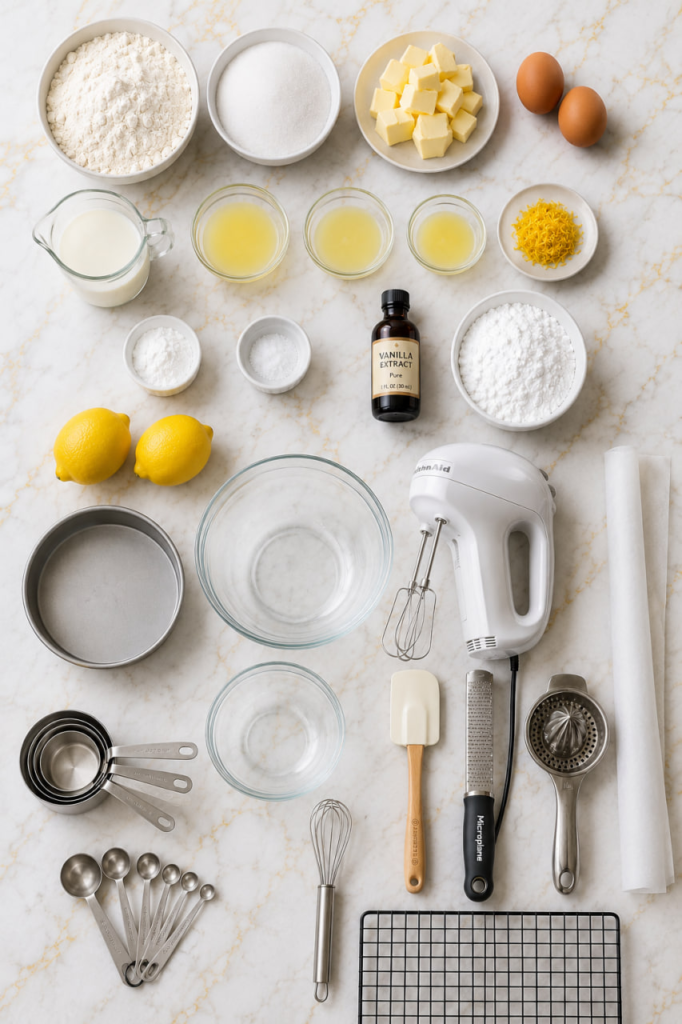
Ingredients
- 2 cupsall-purpose flour
- 1 cupgranulated sugar
- 1/2 cupunsalted butter, softened
- 2large eggs, room temp
- 1/2 cupwhole milk
- 1/4 cupfresh lemon juice (about 2 lemons)
- 2 tbsplemon zest (about 2 lemons)
- 1.5 tspbaking powder
- 1/4 tspfine sea salt
- 1 tsppure vanilla extract
- 1.5 cupspowdered sugar (glaze)
- 3 tbspfresh lemon juice (glaze)
Tools & utensils
- 9-inch round cake pan
- Parchment paper
- Large mixing bowl
- Medium mixing bowl
- Hand mixer or whisk
- Rubber spatula
- Microplane / zester
- Citrus juicer
- Measuring cups & spoons
- Wire cooling rack
- Small bowl (glaze)
- Fork or small whisk
Step-by-step instructions
Step 1
Prep your pan and oven
Preheat your oven to 350°F (175°C). Line a 9-inch round cake pan with a circle of parchment paper, then grease the sides lightly with butter. This guarantees a clean release every time.
Step 2
Cream butter and sugar
In a large mixing bowl, beat the softened butter and granulated sugar together with a hand mixer on medium speed for about 3 minutes, until the mixture is pale and noticeably lighter in texture. This step builds the crumb structure, so don’t rush it. Scrape down the sides of the bowl with a rubber spatula halfway through.
Room temperature butter is non-negotiable here. Cold butter won’t cream properly; melted butter will make the batter greasy. Leave it out for at least 45 minutes before you start.
Step 3
Add eggs, lemon zest, and vanilla
Crack in the eggs one at a time, beating well after each addition. Mix in the lemon zest and vanilla extract. The batter may look slightly curdled — that’s fine. It will smooth out once the dry ingredients are added.
Step 4
Combine dry ingredients
In a medium mixing bowl, whisk together the all-purpose flour, baking powder, and fine sea salt until evenly distributed. This quick step prevents clumps of baking powder from sitting unevenly in the batter.
Step 5
Alternate wet and dry
With the mixer on low, add the flour mixture to the butter mixture in three additions, alternating with the milk and lemon juice (start and end with the flour). Mix only until just combined after each addition. Overmixing at this stage develops gluten and toughens the crumb.
Step 6
Bake
Pour the batter into your prepared pan and smooth the top with a rubber spatula. Bake at 350°F for 30 to 35 minutes, until the top is golden and a toothpick inserted in the center comes out clean. Start checking at the 28-minute mark since ovens vary.
Resist opening the oven door before 25 minutes. The sudden drop in temperature can cause the center to sink.
Step 7
Cool the cake
Let the cake rest in the pan on a wire rack for 10 minutes, then turn it out and peel away the parchment. Allow it to cool completely before glazing — at least 45 minutes. Glazing a warm cake causes the icing to slide off and disappear into the crumb.
Step 8
Make the lemon glaze
Whisk together the powdered sugar and fresh lemon juice in a small bowl until smooth and pourable. If it’s too thick, add lemon juice a half teaspoon at a time. Pour the glaze over the cooled cake and let it drip naturally down the sides. Leave it to set for 15 minutes before slicing.