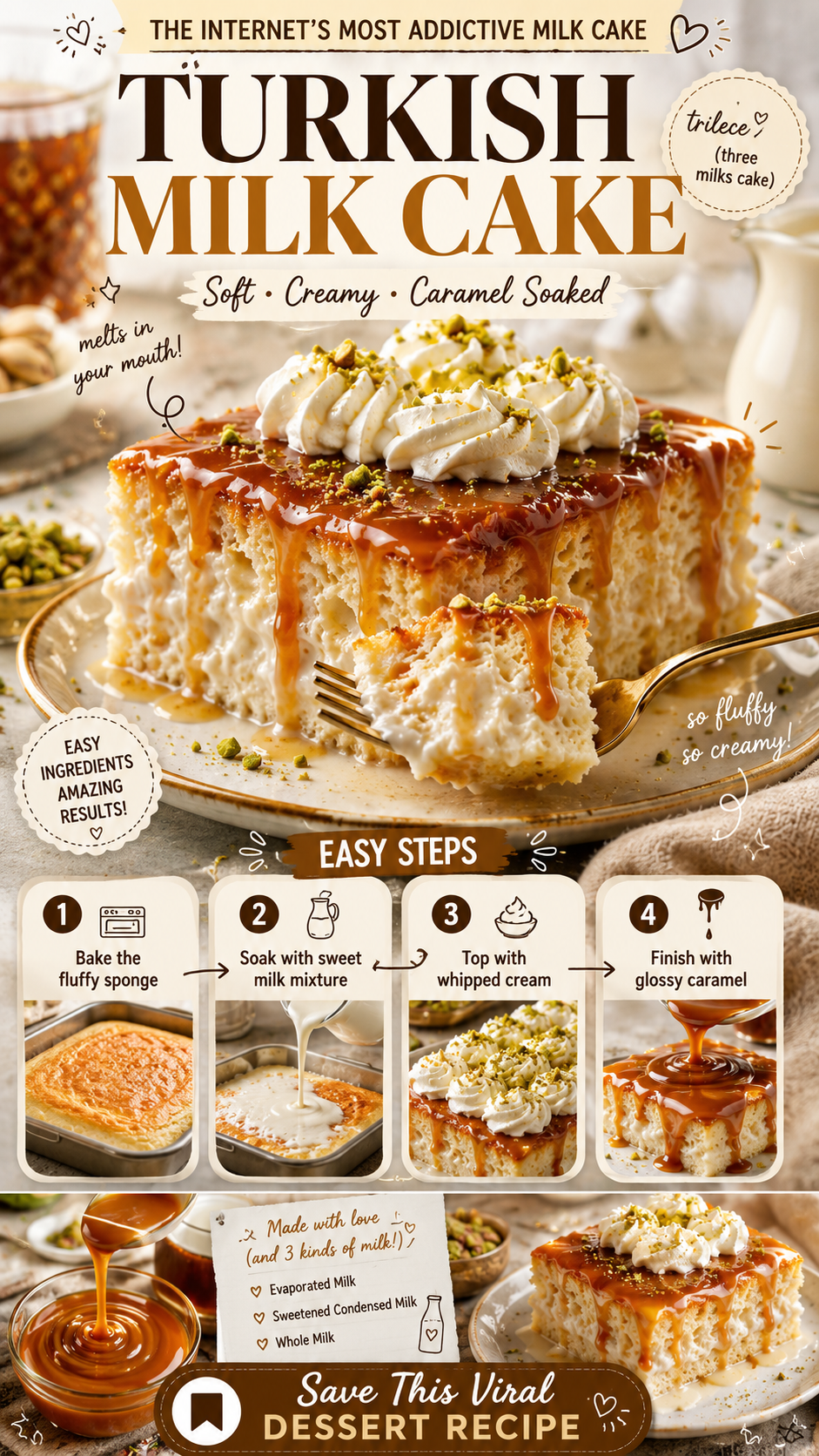
You’ve made cakes before. Probably dozens of them. But I can almost guarantee you’ve never made one quite like this.
Turkish Milk Cake — known in Turkey as Süt Kek — is the kind of dessert that looks unassuming, takes almost no effort, and then completely wrecks you for every other cake you’ve ever loved. 😍
It’s pillowy soft. Lightly sweet. Soaks up a warm milk mixture that seeps into every single crumb. It’s the dessert equivalent of a warm hug — and you’ll want to make it every single week once you try it.
Here’s the thing people don’t expect: this cake gets better the longer it sits. That’s the twist you’ll want to stick around for.
Recipe at a Glance
| Detail | Info |
|---|---|
| Prep Time | 15 minutes |
| Cook Time | 30–35 minutes |
| Soaking Time | At least 1 hour (overnight is best) |
| Total Time | ~50 minutes + soaking |
| Servings | 12 slices |
| Difficulty | Easy |
| Diet | Vegetarian |
What Is Turkish Milk Cake?
Süt Kek is a traditional Turkish sponge cake that gets soaked in a warm, sweetened milk mixture right after baking.
Think of it as the Turkish cousin of tres leches — but lighter, less rich, and somehow even more satisfying.
The sponge itself is fluffy and delicate. Then you pour the warm milk mixture over the still-hot cake and let it absorb fully. What you’re left with is a cake that’s moist all the way through — not soggy, not heavy, just perfectly tender from crust to center.
It’s popular all over Turkey as an everyday dessert, served at family gatherings, tea times, and pretty much any occasion where someone decides they deserve something sweet (which should be always).
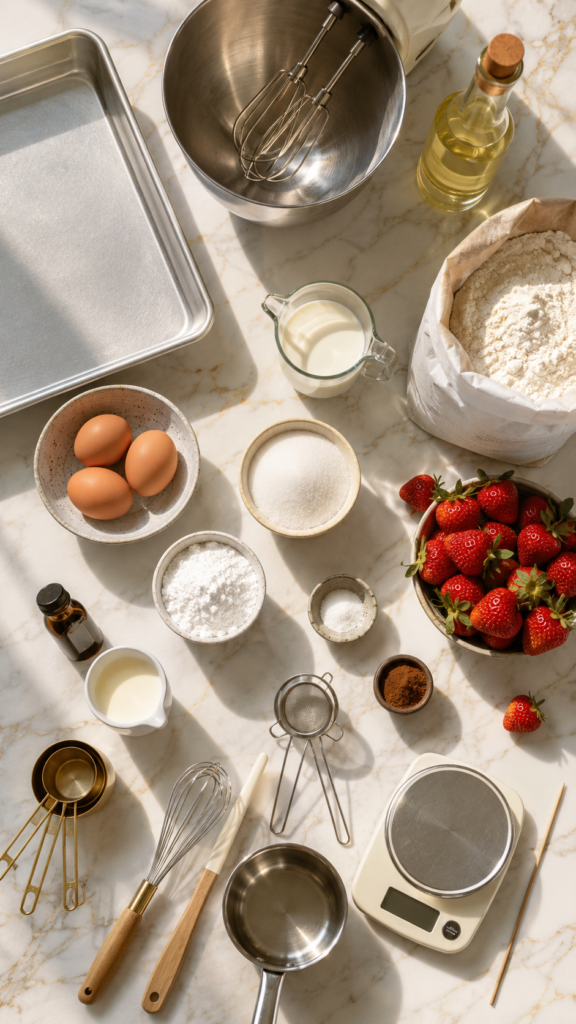
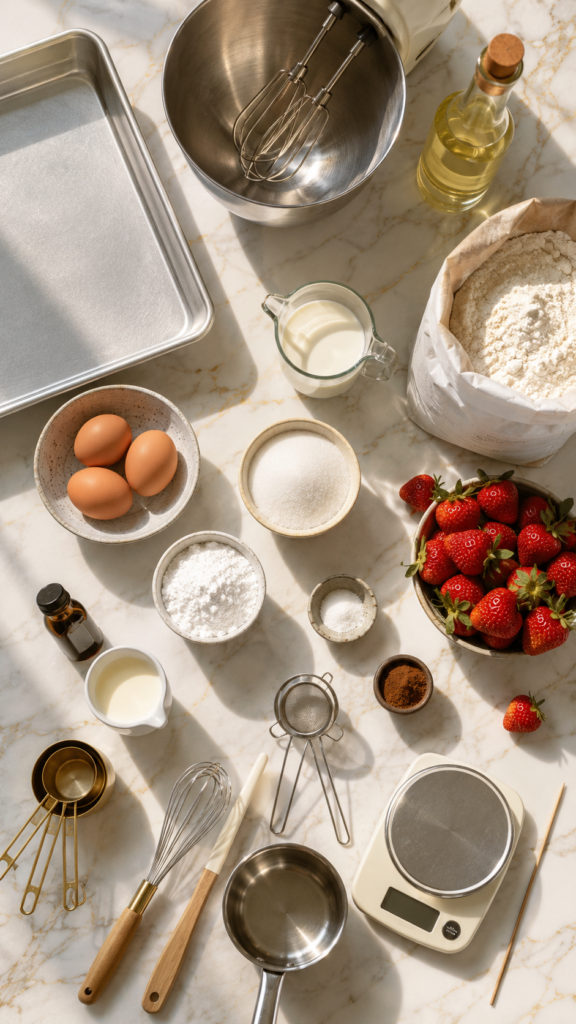
What You’ll Need
For the Cake
- 3 large eggs, room temperature
- 1 cup (200g) granulated white sugar
- 1 cup (240ml) whole milk
- ½ cup (120ml) vegetable oil (or sunflower oil)
- 1 tsp pure vanilla extract
- 2 cups (250g) all-purpose flour
- 1 tbsp baking powder
- ¼ tsp fine salt
For the Milk Soak
- 2 cups (480ml) whole milk
- 3 tbsp granulated white sugar
- 1 tsp pure vanilla extract
For Topping (Optional but Highly Recommended)
- 1 cup (240ml) heavy whipping cream
- 2 tbsp powdered sugar
- ½ tsp pure vanilla extract
- Ground cinnamon, for dusting
- Fresh strawberries or sliced peaches, for serving
Tools You’ll Need
- 9×13 inch (23×33 cm) baking pan
- Stand mixer or hand mixer with beaters
- Two large mixing bowls
- Whisk
- Rubber spatula
- Sifter or fine mesh sieve
- Small saucepan
- Toothpick or skewer (for testing doneness)
- Knife or skewer (for poking holes)
- Measuring cups and spoons
- Kitchen scale (for accuracy)
- Wire cooling rack
Pro Tips
These are the things I wish someone had told me the first time I made this. Trust me, they matter.
1. Room temperature eggs are non-negotiable. Cold eggs don’t whip up as well, and you’ll lose the volume that makes this cake so fluffy. Pull them from the fridge 30 minutes before you start.
2. Whip the eggs and sugar longer than you think. This is the secret to the pillowy texture. You want the mixture to be pale, thick, and ribbon-like — at least 4 to 5 full minutes in a stand mixer. Don’t rush this step.
3. Pour the milk soak while the cake is still warm — not cool. A warm cake absorbs the milk soak beautifully. If you wait until it’s fully cooled, the sponge tightens up and doesn’t soak as deeply.
4. Poke holes generously before soaking. Use a skewer or fork and poke holes every inch across the entire cake. More holes = more milk absorption = more incredible cake.
5. Give it overnight if you can. An hour of soaking is enough. But overnight? That’s when the magic truly happens. The texture becomes silkier and the flavors meld together in a way that’s almost unfair.
Substitutions and Variations
This recipe is flexible. Here’s how to make it work for you:
Milk options
- Whole milk gives the richest result
- 2% milk works fine for a lighter soak
- Oat milk or almond milk can work for a dairy-light version (just skip the whipped cream or use coconut cream)
Oil options
- Sunflower, canola, or any neutral vegetable oil works well
- Melted butter can replace the oil for a slightly richer cake
Flour options
- All-purpose flour is standard
- Swap in 1:1 gluten-free flour blend if needed (texture will be slightly denser)
Topping variations
- Kaymak (Turkish clotted cream) instead of whipped cream for the most authentic experience
- Drizzle of honey instead of powdered sugar
- Top with pomegranate seeds for a gorgeous, tangy contrast
- Add a sprinkle of crushed pistachios for crunch and color
Flavor variations
- Add 1 tsp of almond extract for a subtle nutty flavor
- Stir ½ tsp of cardamom into the flour for a warm, spiced twist
- Add 2 tbsp of cocoa powder to the flour for a chocolate version
Make-Ahead Tips
This cake is practically made to be prepped in advance.
- Bake the cake a day ahead and let it soak in the milk mixture overnight in the fridge. The texture the next day is absolutely worth it.
- Make the whipped cream up to 4 hours ahead and keep it covered in the fridge. Give it a quick re-whip before serving if needed.
- The milk soak can be made 2 days ahead and stored covered in the fridge. Warm it gently on the stove before pouring over the cake.
Nutritional Breakdown (Per Slice, Approximate)
Based on 12 servings, without whipped cream topping
| Nutrient | Amount |
|---|---|
| Calories | ~280 kcal |
| Carbohydrates | 38g |
| Protein | 6g |
| Fat | 11g |
| Sugar | 22g |
| Sodium | 115mg |
| Calcium | 110mg |
Want a lighter version? Cut sugar in the milk soak to 2 tbsp and skip the whipped cream topping. Still incredibly delicious.
How to Make Turkish Milk Cake
Step 1: Prep Your Pan and Oven
Preheat your oven to 350°F (175°C).
Grease your 9×13 inch baking pan well, then lightly flour it or line it with parchment paper. Set it aside.
Step 2: Whip the Eggs and Sugar
In a large bowl (or stand mixer), beat the 3 large eggs and 1 cup of granulated sugar together on medium-high speed for 4 to 5 minutes.
You’re looking for a pale, thick, ribbon-like mixture. When you lift the beater, the batter should fall slowly in a thick ribbon. This is what creates the cake’s signature fluffiness.
Don’t skip this step or rush it.
Step 3: Add the Wet Ingredients
Reduce the mixer to low and add:
- 1 cup whole milk
- ½ cup vegetable oil
- 1 tsp vanilla extract
Mix until just combined. The batter will look thin — that’s totally fine.
Step 4: Fold in the Dry Ingredients
In a separate bowl, sift together:
- 2 cups all-purpose flour
- 1 tbsp baking powder
- ¼ tsp fine salt
Add the dry ingredients to the wet mixture in two additions, folding gently with a rubber spatula after each addition. Stop as soon as no flour streaks remain. Don’t overmix — this is what keeps the cake tender.
Step 5: Bake
Pour the batter into your prepared pan and spread it evenly.
Bake for 30 to 35 minutes, or until the top is golden brown and a toothpick inserted in the center comes out clean.
Step 6: Make the Milk Soak
While the cake is in the oven, combine in a small saucepan:
- 2 cups whole milk
- 3 tbsp granulated sugar
- 1 tsp vanilla extract
Warm over medium-low heat, stirring occasionally, until the sugar dissolves and the mixture is steaming (not boiling). Remove from heat.
Step 7: Soak the Cake
As soon as the cake comes out of the oven, use a skewer or fork to poke holes all over the surface — every inch or so, going deep.
Slowly pour the warm milk mixture evenly over the entire cake. It might look like too much liquid. It’s not. Pour it all on.
Let the cake cool to room temperature in the pan. Then cover and refrigerate for at least 1 hour, or overnight if you can wait.
Step 8: Make the Whipped Cream (Optional)
Just before serving, beat together:
- 1 cup heavy whipping cream
- 2 tbsp powdered sugar
- ½ tsp vanilla extract
Whip on high speed until stiff peaks form.
Spread or pipe over the top of the cooled cake.
Step 9: Finish and Serve
Dust the top with ground cinnamon and serve with fresh strawberries or sliced peaches on the side.
Cut into squares and serve cold. Try not to eat three pieces immediately. (You won’t succeed, but points for trying.)
Meal Pairing Suggestions
Turkish Milk Cake pairs beautifully with:
- Turkish tea (çay) — the classic pairing; the slight bitterness of the tea cuts through the sweetness perfectly
- A scoop of vanilla or pistachio ice cream — especially in summer
- Fresh fruit — strawberries, peaches, and cherries all work really well alongside the creamy cake
- Strong black coffee — for afternoon dessert with a little kick
Leftovers and Storage
Good news: this cake stores like a dream.
- Refrigerator: Keep the cake covered tightly in the pan (or transfer to an airtight container) for up to 4 days. It actually tastes better on days 2 and 3.
- Freezing: You can freeze individual slices (without whipped cream) wrapped tightly in plastic wrap and stored in a freezer-safe bag for up to 1 month. Thaw overnight in the refrigerator.
- Do not leave at room temperature for more than 2 hours — because of the milk soak, it needs to stay chilled.
FAQ
Can I make this without a stand mixer?
Absolutely. A hand mixer works just as well. Just make sure you whip the eggs and sugar for the full 4 to 5 minutes — that’s where the fluffiness comes from.
My milk soak isn’t being absorbed. What went wrong?
A few possible reasons: the cake was too cool when you poured the soak (warm cake absorbs better), or you didn’t poke enough holes. If this happens, just let it sit longer — give it a gentle push with a spoon around the edges to help it along.
Can I use a different pan size?
Yes, but it’ll change the bake time. A 9-inch round pan will give you a thicker cake that needs more time (around 38–40 minutes). Just test with a toothpick.
Is this the same as tres leches?
They’re similar in concept — a milk-soaked sponge cake — but different in execution. Tres leches uses three kinds of milk (whole milk, evaporated milk, and sweetened condensed milk) for a much richer, denser result. Süt Kek uses a simpler milk soak and has a lighter, airier texture.
Can I make it dairy-free?
You can try it with oat milk or almond milk in both the cake batter and the soak. The result will be slightly less rich but still delicious. Use coconut cream in place of heavy cream for the topping.
How do I know when the cake is done?
The top should be golden brown and spring back when you gently press it. A toothpick inserted in the center should come out clean (no wet batter — a few moist crumbs are fine).
Does it have to be refrigerated before serving?
Yes. The soaking and chilling period isn’t just for flavor — it gives the milk time to fully absorb and the texture time to set. Serving it warm or right away won’t give you the same result.
Wrapping Up
This is one of those recipes that seems too simple to be as good as it is. A basic sponge cake. A warm milk soak. A little patience overnight. That’s genuinely it.
And yet, the first time you cut into it and see how evenly that milk has soaked through every last crumb — you’ll get it immediately.
Turkish Milk Cake earns a permanent spot in your recipe rotation. It’s low effort, crowd-pleasing, makes-ahead-beautifully, and tastes like something that took you way longer than it did. That’s a rare combination.
Give it a try this week and come back to tell me how it went. Did you do the overnight soak? Add pistachios on top? Try it with kaymak? I want to hear all about it in the comments below — and if you have any questions, drop those too. 👇